Do we need to fear the sun?

There is nothing like a bright sunny summer day to lighten up your mood. The sun is an essential component in the process of vitamin D synthesis in our skin, required for normal development and functioning of the bones. Yet exposure to the sun is not without any consequences.

Before talking about the risks associated with sun exposure, let’s have a look at the general principles of ultraviolet radiation (UVR) for a better understanding of what we will be discussing next.

The sun emits UVR which is of three different forms depending on the wavelength: UVA, UVB and UVC.                     

fig. the longer the wavelength of the UVR the deeper the penetration.

Although UVA is less harmful than UVB in its ability to cause cancers, the high amount of UVA that reaches the earth’s atmosphere and the ability of UVA to penetrate deeper into the skin makes protection against UVA it as important as protection against UVB.

How our skin protects us against the harmful UVR?

Besides the ozone layer which absorbs the harmful UVR and preventing it from reaching the earth’s surface, our skin also plays an important role in protecting our body against the UVR.

Our skin acts an effective barrier preventing the penetration of the UVR beyond the dermis (deeper layer of skin) and into the internal organs. Our skin is also equipped with various defence mechanisms such as enzymes and antioxidants which help repair the damage to the cells produced by UV exposure.

But in the process of protecting us from the UVR, certain light absorbing substances (called chromophore) undergoes a photo-chemical reaction that results in damage to the skin cells which results in sunburn, allergic reactions to the sun and if the body fails to repair the damage, the mutations can lead to skin cancers. Therefore the skins bears the maximum detrimental effect of the sun. 

So, do we need to fear the sun?

My answer is “YES”, especially if you’re person with Fitzpatrick skin type I-II, who have the maximum risk of UV induced skin cancers (see the previous blog post: “Do you know your skin type?“). Sun protection in these individuals is necessary from a very young age as risk of melanoma (a malignant cancer of the skin) is more with intense intermittent sun exposure from a very young age.

Sun protection is also necessary to prevent early signs of ageing and for individuals with pigmentation disorders or individuals with photodermatosis ( skin diseases caused solely due to the body’s abnormal response to the UVR) or genetic disorders such as xeroderma pigmentosa (inherited disease caused by a mutation that affects the ability of the body to repair the DNA damage produced by the sun).

That being said, fearing the sun does not mean you live under a rock and never see the sunlight again. As I did mention we need the sun for Vitamin D synthesis, and a few minutes of sun exposure two times a week is adequate for this normal process to occur. My advice is for you to understand when and where the danger lies and how to minimise it.

When and where is the sun’s UVR the maximum?

Areas near the equator receives maximum UVR.

fig. the red band represents where earth receives maximum UVR.

Higher the altitude more the UVR (Shimla, Jammu and Kashmir etc), even though these places are relatively colder, sun protection is still a must due to the shorter UVR path.

The time of the day when the sun is directly overhead i.e around noon time (9am- 3pm) is the time when sun protection has to be at its maximum. Early morning and late afternoon sun’s rays are directed at an angle to the earth’s surface and are mostly absorbed.

What if it is cloudy outside?

Clouds can reduce (though not by a great amount) the UVR reaching the earth but in days with scattered clouds, the UVR may even be more as most of the radiation are scattered. So my fellow Meghalayians (people hailing from a state in India call Meghalaya), you still need that sunscreen even if you live in a state whose name literally translates to the “Abode of clouds”

Abode of the Clouds (CC BY 2.0: Rajesh Dutta)

And what if its snowing outside?

Snow and sand, sea, are a good reflector of UVR which can double the risk of UV exposure.

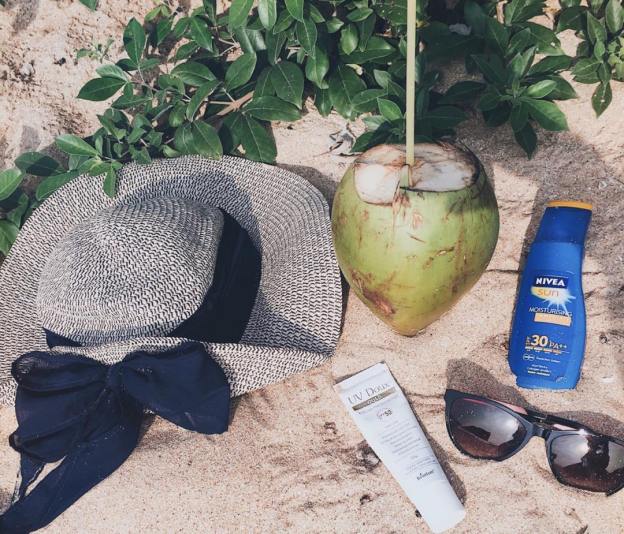
In future posts we will explore the ways of proper sun protections. In the meantime remember that packing a sunscreen for your skiing trip at the Alps is as important as packing your sunscreen for a day at the beach.
Do you know your Skin Type?

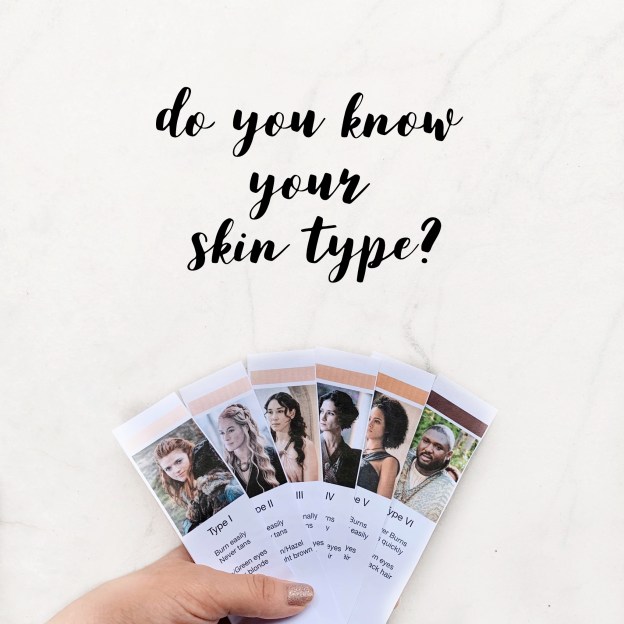
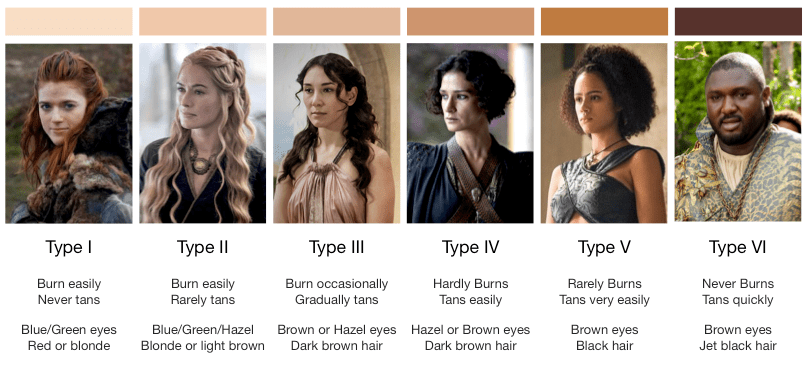
Dermatologist used a scale called Fitzpatrick scale or Fitzpatrick skin type (FST) to classify the various types of skin tone based on the response of the skin to ultra-violet radiation (UVR). According to this scale there are 6 skin types.

fig. Fitzpatrick skin types in Westeros.

What determines your skin type?

The skin is composed of several layers of cells. The melanocytes, which are cells present in the epidermis (the superficial layer of the skin), are responsible for the variation in the skin colour of human race. Note that it is not the number of melanocytes but the size of the melanosomes and the type of pigment produced by these cells (also called the activity of the melanocytes) that determine the skin colour of an individual.

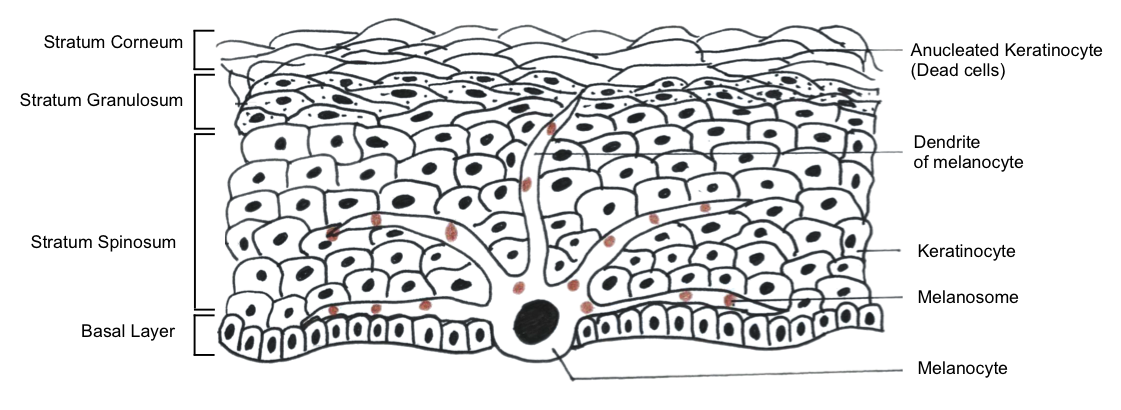
One melanocyte is associated with 30-40 (1:36) surrounding keratinocytes, which are the fundamental cells of skins. The keratinocytes engulf the melanosome containing melanin (pigment responsible for skin color) which results in the skin pigmentation.

fig. layers of epidermis showing melanocytes and keratinocytes

Effect of the sun on skin pigmentation 

A single exposure to UVR increases the size of the melanocyte with increase in the activity of the enzyme required for melanin synthesis (tyrosinase). Repeated UVR exposure leads to increase in the number of highly active melanosomes as well as increase transfer of melanosomes to the neighbouring keratinocyte which results in tanning (see the little brown dots in the above diagram).

What is the role of tanning?

You can think of tanning as a way the skins naturally defends itself against the oxidative stress produced by the sun exposure. Tanning is physiological protective response to UVR. Melanin acts as a natural antioxidant which quenches the harmful oxidative radicals produced by the chemical reaction which takes place on UV exposure.

Melanin provides a natural sun protection factor (SPF) of 13.4 in black individuals and only 3.4 in pale skin individuals.

Individuals with FST I, II who do not tan with sun exposure are at higher risk of developing skin cancers.

Influence of fashion

The fashion trend influences pale skin individual to desire a darker skin tone which leads them to go through extensive lengths to obtain that “perfect tan” either by prolonged sunbathing at the beach or by artificial tanning machines without considering the risk they impose on their health in the name of “beauty”.

On the other hand darker skin individuals with relatively lesser risk of cutaneous cancers from UVR ironically hide from the sun as society has made them believe that fairer skin is synonymous with beauty.

Fun fact: FST also forms the basis for the variation in skin colour in emojis with FST I & II merged together.

Why do you need to know your skin type?

Knowing your skin type helps you understand the risk of developing skin cancers with UV exposure. Individuals with FST I, II need to strictly adhere to proper sun protection in the form of broad spectrum high SPF sunscreen and protective clothing especially if they are living in tropical countries.

Disorders of pigmentation like melasma, or pigmentation that can occur from either disorders such as acne, or as a complication of procedures such as LASERS, or chemical peels, etc. are more common in individuals with darker skin tone (FST III,IV,V VI). Therefore caution must be taken while carrying out procedures in such individuals.

Consumers must also understand that some studies on the efficacy of certain active ingredients for a particular disorder are performed solely in individuals of lighter skin tone and the same results may not reflect in their skin type. Therefore referring to studies done on individuals of same ethnicity holds more value. For example you should search for studies done on Indian population if you are Indian.

The Journey Begins

Good company in a journey makes the way seem shorter“.

Izaak Walton

Hi, I’m Dr Naphi, just completed my three year residency course in MD Dermatology, Venereology and Leprosy from Goa Medical College, India. I’m glad to say I received my result on the MD dermatology exam and I’m official a board certified dermatologist. I was born and brought up in Shillong, India but have been a away from home for my education for over 9 years now. I do hope that someday I will be able to return back home and practice in my hometown.

I started this blog so that I’ll be able to share what I’ve learn and continue to learn in this field hoping that it will help you better understand dermatological issues and care for it accordingly.

I am also hoping to be able to spread some awareness regarding chronic dermatological diseases and diseases that are highly stigmatised in society and maybe in time help to change people’s perspective on these issues. I’m looking forward to be able to bring together individuals that may be suffering from the same condition and connect with each other through this platform.

I thank you for joining me through this journey.